
When creating marbled papers, the materials you choose to work with will greatly influence your workflow. It might sound obvious, but unlike other art forms where you can get good or at least interesting results experimenting with different types of media, instead, when creating marbled papers choosing the wrong ingredients and materials will impact your results dramatically. You can go from “Beautiful and astonishing” to ” Miserable Failure” with little to zero margin of error. The worst part of failing when marbling papers is that you may realize your mistakes only at the end of the process, looking with profound sadness that your colors are washing off the paper while you’re rinsing them. It is heartbreaking. I’ve been there so many times…
When choosing the right papers for marbling one must take into consideration some very important aspects:
- You need papers that are not coated (shiny papers won’t work)
- Even when the papers have a natural and mat finish, you must verify that thy’re UNBUFFERED.
This is not an easy-to-spot characteristic and you can only be sure that you’re working with an unbuffered paper calling the company that manufactures the paper.
To understand better what all this buffering is and how it affects paper marbling I suggest you to read this article on TALAS website. And in the case the website is not reachable anymore you can get a pdf copy of the article here. - The weight of the paper will determine the use you can make of it. Lighter papers are nice for book’s endpapers, heavier ones won’t work for that.
Finding Unbuffered paper is very difficult these days and there are some papers that even if buffered, they will work. Which paper to use is no easy question after all.
To Alum or NOT to Alum:
****
Paper curling problem:
There’s a very good explanation from Mrs. Laura Berretti from Marbled Arts (Facebook page) on the International Marbling Network (Facebook Group) that explain in a really comprehensive, I’m citing it here in case the day comes when Facebook ceases to exist 🙂
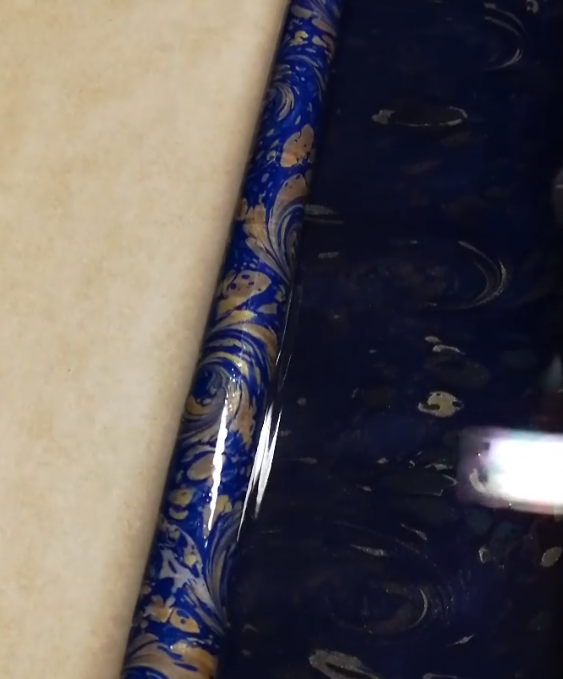
To produce marbled paper in a low air humidity atmosphere can be quite a challenge. The paper has the natural characteristic to release or soak moisture from/to the air. This way the paper tends to adjust to the same air humidity it is being exposed. This behave varies greatly and depends on many variables such as materials used in the paper making, internal and surface sizing, pressing and drying method, etc.
The paper starts to get difficult to handle when air humidity drops below 50%. The problem is that, as the paper is crispy dry, the moment it touches the liquid surface, it rapidly starts to soak up the moisture and so it expands and starts to curl. The curling starts within a couple seconds after the contact so you have a window of 5 to 6 seconds to lay down the entire sheet before the curling reaches the paper – liquid surface contact point and ruins the printing causing a disruption in the pattern.
Interesting fact: The observation of this phenomenon alone can ascertain the viewer about the paper grain direction: The curling takes place in the same edges that corresponds to the paper grain direction. That means the fibers are aligned parallel to that curling edge. If the curling happens in the long edges, the paper is said to be a long grain paper, if the curling takes place at the short edges, it is a short grain paper.
(Link to the original post on faccebook)
****
I’ll list here the papers I’ve been using with a certain rate of success:
- Fabriano
A list of papers that have been used with good results from the comunity:
- dorée / Strukturiertes Zeichenpapier/Vorsatzpapier – (link german)
- Hahnemühle / Carta di guardia, 50 x 70 cm – (link italian | link german)